
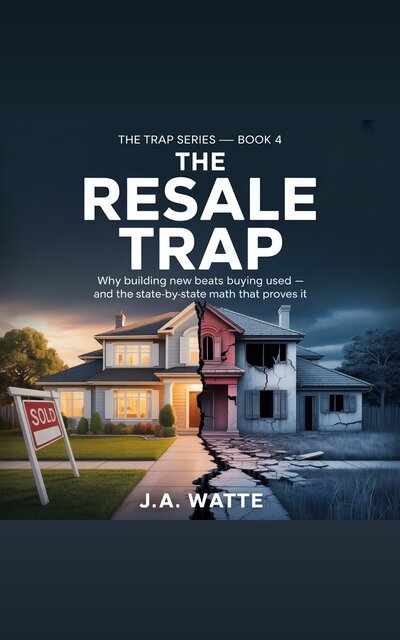
The Resale Trap
Why building new beats buying used — and the state-by-state math that proves it.
The math your real estate agent will never show you. 395 pages of sourced data.
For homeowners 6 to 12 months from listing, and buyers comparing new construction against resale in their state.
Save $10,000–$20,000 in listing commission, post-NAR settlement.
The Commission Savings Calculator compares a flat-fee MLS service (Fizber, Homecoin, Beycome, Houzeo, or GetRidley) plus a title company and an optional real estate attorney against the standard 5–6% commission. It is state-aware. It includes Colorado's 0.5% closing-fee equivalent and the 22 states that require an attorney.
A $400K resale home costs $318K–$506K more to own across 25 years than a comparable $400K new build once the full model is run. The model counts maintenance escalation, insurance compounding at 8–10% CAGR, repair cycles for roof, HVAC, water heater and siding, material wear, and the lost return on every repair dollar. The Resale Trap maps the gap year by year across all 50 states using NAHB, RS Means, FHFA, BLS, and Harvard JCHS data.
Written for People Who Want the Math, Not the Marketing
First-Time Buyers
See the real total cost before you sign. The 25-year model shows costs no listing will reveal.
Current Homeowners
Run maintenance-adjusted returns on your property. Find out if your "investment" is actually losing money.
Real Estate Investors
Insurance float mechanics, CAT bond markets, and the carrier exit pipeline that affects your portfolio.
Relocators
All 50 states ranked on an 8-dimension composite score. Know before you move.
Prospective Builders
Production builder vs. custom build decision framework. Land Investability Score. The how-to playbook.
Data-Driven Readers
Every claim sourced from NAHB, RS Means, FHFA, BLS, Census, Harvard JCHS, and more. No opinions — math.
7 Parts. 22 Chapters. One Argument.
From the builder's hidden margin to the system that keeps it all in place.
The Markup
Builder margins, material tiers, real construction costs.
The Real Gain
Maintenance-adjusted returns, opportunity cost, inflation.
The Insurance Machine
The float, CAT bonds, carrier exits, consolidation.
The Premium Illusion
Master plans, vacation props, premium-adjusted value.
State-by-State Math
Available salary, donor states, 50-state rankings.
The Playbook
How to build, land scoring, when building doesn't work.
The System
Data errors, tax illusions, the return that isn't there.
What No Other Book Covers
The Resale Trap is the first book to quantify the full ownership cost. Here's how it stacks up.
| Feature | Zillow.com (Online Guides) |
Millionaire RE Investor (Keller, 2005) |
Home Buying Kit For Dummies (Tyson, 2020) |
The Resale Trap |
|---|---|---|---|---|
| 25-Year Total Cost of Ownership Model | ✕ | ✕ | ✕ | ✓ |
| All 50 States Ranked (8-Dimension Score) | ✕ | ✕ | ✕ | ✓ |
| Insurance Float & CAT Bond Mechanics | ✕ | ✕ | ✕ | ✓ |
| Maintenance-Adjusted Return Analysis | ✕ | ~ | ✕ | ✓ |
| Material Tier Comparison (1/2/3) | ✕ | ✕ | ~ | ✓ |
| Production Builder vs Custom Framework | ~ | ✕ | ~ | ✓ |
| Land Investability Score | ✕ | ✕ | ✕ | ✓ |
| Donor State vs Recipient State Analysis | ✕ | ✕ | ✕ | ✓ |
| Insurance Carrier Exit Pipeline | ✕ | ✕ | ✕ | ✓ |
| Mello-Roos / Metro District / MUD | ✕ | ✕ | ✕ | ✓ |
| Every Claim Cited to Institutional Source | ~ | ✕ | ~ | ✓ |
| Opportunity Cost of Locked Equity | ✕ | ~ | ✕ | ✓ |
The Math Nobody Else Runs
— Chapter 4: Maintenance-Adjusted ReturnsMost real estate books stop at the purchase price. The Resale Trap models seven cost dimensions over 25 years: maintenance, insurance, capex, property tax, opportunity cost, inflation, and material wear. The data comes from NAHB, RS Means, FHFA, BLS, and Harvard JCHS.
— Part III: The Insurance MachineHomeowner insurance premiums have compounded at 8–10% annually for over a decade. The gap between new-build and resale premiums is widening as carriers reprice risk. Chapters 7–8 of The Resale Trap explain the float mechanics, CAT bond markets, reinsurance repricing, and the carrier exits across Florida, Texas, California, and Louisiana. No other real estate book covers them. Older homes pay far more, and Insurance Information Institute and NAIC data back every claim.
— Part V: The State-by-State MathEvery state is scored across 8 dimensions: Available Salary, property tax, insurance cost, construction cost per SF, land availability, water quality, natural hazard exposure, and regulatory climate. Chapter 14 ranks all 50 and shows you the math.
— Part VI: The PlaybookThe Resale Trap is not a sales pitch for builders. Chapter 17, "When Building Doesn't Make Sense," covers the markets and buyer profiles where resale wins. Those include low-land-cost metros, well-built pre-1985 housing stock, short hold timelines, and tight labor markets that push new-build costs past break-even. The framework runs on public data, so a reader can rerun the math for their own market. 395 pages, every claim sourced, 3 appendices, Land Investability Score worksheet included.
Frequently Asked Questions
The Resale Trap is the first book to quantify the full 25-year total cost of ownership — maintenance, insurance, capital expenditure, opportunity cost, and inflation — and compare resale homes against building new, state by state. It proves that a $400K resale costs $318K–$506K more to own over 25 years than a $400K new build.
Yes. Chapter 14 ranks every state using an 8-dimension composite score: Available Salary, property tax burden, insurance cost, construction cost per square foot, land availability, water quality, natural hazard exposure, and regulatory environment. Each dimension is scored and weighted using NAHB, FHFA, BLS, Harvard JCHS, NAIC, and EWG data. North Carolina, Tennessee, Texas, Indiana, and Georgia currently lead the 2026 build-new rankings. Florida, California, and Louisiana are flagged for insurance repricing distortion.
The Resale Trap is written for anyone preparing to buy or build a home in any of the 50 US states. It also serves current homeowners wondering whether their 25-year total cost matches the marketing brochure, investors running BRRRR or buy-and-hold math, and relocators weighing states against each other. The book is data-driven across NAHB, RS Means, FHFA, and Harvard JCHS data. It is written for readers who want math, not marketing platitudes.
Most real estate books assume appreciation equals wealth. The Resale Trap runs the maintenance-adjusted math and shows that the real return is often negative after accounting for deferred maintenance, insurance escalation at 8-10% CAGR, material degradation, and opportunity cost. The insurance chapters (7-8) covering float mechanics and CAT bond markets have no equivalent in existing real estate literature.
Yes — Book 4 of The Trap Series. The W-2 Trap (Book 1) covers wage dependency and 80+ exit strategies. The $97 Launch (Book 2) is the business-building playbook. The Condo Trap (Book 3) exposes the 7 forces destroying condo value. Each book stands alone.
Every data claim is sourced. Institutional sources include NAHB, RS Means, FHFA HPI, Harvard Joint Center for Housing Studies, Cotality, BLS, Census Bureau, Insurance Information Institute, and NAIC. The book includes endnotes, an appendix detailing the 25-year cost model methodology, and references to downloadable tools.
Rich Dad Poor Dad teaches the concept of assets vs liabilities but never quantifies the 25-year total cost of owning a home. The Resale Trap picks up where Kiyosaki stops — running the maintenance-adjusted, insurance-escalated, state-by-state math that proves which type of "asset" actually builds wealth.
BiggerPockets teaches excellent deal analysis for rental properties. But the BRRRR strategy relies on resale homes — which means inheriting deferred maintenance, material tier risk, and insurance premium escalation. The Resale Trap quantifies those hidden costs across all 50 states and shows when building new produces better long-term returns than rehabbing existing inventory.
A $400K resale home costs $318K-$506K more than a comparable new build over 25 years once you account for maintenance escalation, insurance compounding at 8-10% CAGR, capital expenditure cycles (roof, HVAC, plumbing), and the opportunity cost of money spent on repairs instead of invested. The Resale Trap models every cost year by year using institutional data.
The insurance float is the pool of money carriers hold between collecting premiums and paying claims. Carriers invest this float for profit — your $4,000 annual premium generates investment income while you wait for a claim that may never come. This incentive structure explains why premiums rise even when claims fall. Read the full breakdown.
Based on the 8-dimension composite score in Chapter 14, the top states for building new in 2026 include North Carolina, Tennessee, Texas, Indiana, and Georgia — driven by favorable construction costs, lower insurance burdens, available salary ratios, and regulatory environments that support new development. See the full state rankings.
Kiyosaki's asset-vs-liability framework is directionally useful, but Rich Dad Poor Dad never quantifies the 25-year total cost of owning a home. It treats all real estate as an asset without distinguishing between new construction and resale, or accounting for insurance escalation, material degradation, and capex cycles. Read the full comparison.
The Land Investability Score is a 10-factor framework from Chapter 16 for evaluating buildable lots. It scores soil and slope conditions, utilities access, zoning compatibility, flood zone status, proximity to services, road frontage, environmental constraints, title clarity, HOA restrictions, and market trajectory. Each factor is weighted to produce a composite score that helps prospective builders compare parcels objectively.
Insurance premiums have compounded at 8-10% annually for over a decade. On a resale home, this escalation is worse because older homes carry higher risk ratings, lack modern building code compliance, and may sit in areas where carriers are exiting. Over 25 years, the insurance cost differential between a new build and a resale can exceed $100K. Learn more about the insurance crisis.
Production builders like Lennar, D.R. Horton, and NVR construct homes at scale using standardized floor plans, volume purchasing, and streamlined processes. They typically cost 15-25% less per square foot than custom builders. For most buyers, production builders offer the fastest and most affordable path to new construction. Compare production vs custom builds.
Yes — The Resale Trap focuses exclusively on single-family residential homes. Condominiums have an entirely different cost structure driven by HOA assessments, special assessments, reserve fund underfunding, and energy mandate compliance. Those issues are covered in The Condo Trap (Book 3 of The Trap Series).
The Zestimate has a national median error rate of roughly 6-7% for off-market homes and 2-3% for on-market listings. It cannot account for deferred maintenance, material tier quality, insurance risk factors, or interior condition — all of which significantly affect the true total cost of ownership. Read the full Zestimate analysis.
Every claim is sourced from institutional data including NAHB (National Association of Home Builders), RS Means construction cost data, FHFA House Price Index, BLS Consumer Price Index, U.S. Census Bureau, Harvard Joint Center for Housing Studies, NAIC (National Association of Insurance Commissioners), Insurance Information Institute, Cotality (CoreLogic), and EWG water quality data. The methodology is documented in Appendix A.
Six Books. One System.
Each book exposes a different mechanism that transfers wealth from working households to asset holders.
The $100 Network
Build a home network that actually works — for under $100.
Amazon Visit Site.Get Housing Data That Matters
New research, state-by-state updates, and cost model insights. No spam. Unsubscribe anytime.
The Spreadsheet Doesn't Care About Your Feelings
395 pages. Every claim sourced. Every cost modeled. See the math before you sign.
Common Questions
Five of the most frequent. Full list at /faq/.
Is it always cheaper to build new instead of buying resale?
No — the book is explicit about when resale wins. Markets with low land cost and aging-but-well-built stock often favor resale. The Resale Trap shows the state-by-state cost model so you can run the numbers for your specific market. The claim is that most buyers never run the math, not that new-build is universally better.
What is the 25-year total cost of homeownership model?
A full-lifecycle calculation that counts mortgage interest, property taxes, insurance, maintenance escalation, and major-system replacements (roof, HVAC, water heater, siding). It also counts utilities and the lost return on the down payment. Resale homes in most states look cheaper at purchase but cost 18-34% more over 25 years once deferred maintenance hits. Appendix A ships the spreadsheet.
How does the book handle state-level data?
All 50 states are modeled with their own insurance rates, property tax rates, utility cost curves, and major-system replacement costs. Florida, Texas, and California get expanded chapters because insurance repricing there distorts the baseline model. If you're in a different state the generic framework applies, and Appendix B lists the data sources for pulling your own numbers.
What about condos? Is this the same as The Condo Trap?
Different book, overlapping thesis. The Resale Trap is about single-family homes — new build vs resale. The Condo Trap is about condos specifically — HOA fees, special assessments, energy mandates, metro-district taxes. If you're deciding between a single-family resale and a single-family new build, this is the book. If you're considering a condo, read The Condo Trap first.
Is this advice or reference data?
Reference data and frameworks, not advice. The book shows you the numbers, the data sources, and the decision framework. Your situation, market, timeline, and risk tolerance are variables you plug into the model. No book should be the sole input on a six-figure decision. Use the worksheet and consult a licensed agent, inspector, and real estate attorney for your transaction.
