
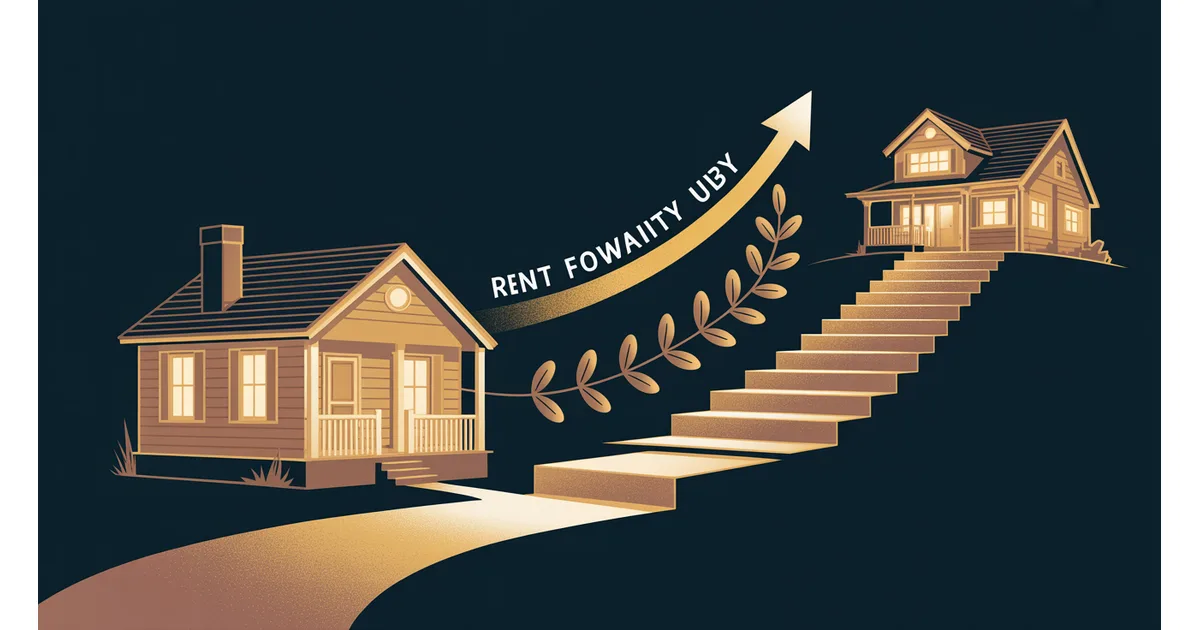
Most first-time buyers hit the same wall. The place you can afford is not the place you want, and the place you want costs far more than your budget allows. So you either stretch into a starter home that already feels like a compromise, or you keep renting and watch prices climb without you.
There is a third path that rarely comes up at the closing table. You buy a small multifamily building (a duplex, triplex, or fourplex), live in one unit, and rent out the rest. Your tenants cover most of your payment. Your equity grows faster than it would in a single-family starter. A few years later you sell or refinance and use that equity to build or buy the home you actually wanted in the first place.
This is called house hacking. It is not new and it is not exotic. Multi-unit buildings have existed for a century. It is just a starter move that pays you while you make it, and for a first-home buyer who genuinely intends to trade up later, that changes the whole timeline.
Why your first house should earn its keep
Here is the resale trap in plain terms. You buy the home you can afford now, live in it a few years, then discover that selling it and moving up costs more than the equity you built. Transaction costs, a higher price tier, and a starter that appreciated slower than the move-up home all work against you. If you are still mapping out the basics, our first-time buyer guide walks through where those costs hide.
House hacking attacks that trap from the front. Instead of a starter home that only costs you money every month, you buy an asset that pays you back. The difference between an $1,800 rent check going out and a tenant's $1,600 rent check coming in is the difference between spinning your wheels and building the down payment for your real house.
What house hacking actually is
The mechanics are plain:
- Buy a two to four unit property using an owner-occupied mortgage.
- Move into one unit (owner-occupied loans require you to live there).
- Rent the other unit or units to tenants.
- Let that rental income cover your mortgage, partially or completely.
The reason this works for first-time buyers specifically is that owner-occupied loans are the cheapest money in real estate. A pure investor putting up no skin gets nowhere near these terms. Because you are living in the building, you qualify for the same low-down, low-rate financing a regular homebuyer gets, and you get to point tenant income at your loan.
The math on a duplex
Here is a real-world example straight from the numbers.
Say you buy a duplex in a mid-market city for $320,000 at 6.5% on a 30-year fixed loan. Principal and interest run about $2,023 a month. Property taxes and insurance add roughly $475. Your all-in monthly cost is about $2,498.
You live in one two-bedroom side. You rent the other two-bedroom side for $1,600 a month.
Your net housing cost drops to about $898 a month. A comparable standalone rental in the same city would run you $1,800 or more. That is roughly $900 a month, or about $10,800 a year, staying in your pocket instead of a landlord's. And that is only the cash-flow piece. Every payment also builds equity, and the building itself tends to appreciate (historically 3% to 5% a year nationally).
Zero down, or close to it
Which loan you use decides how much cash you need to walk in the door.
If you qualify for a VA loan, this strategy is at its cleanest: 0% down and no monthly mortgage insurance, on properties up to four units. There is a one-time VA funding fee (2.15% of the loan on a first use with no money down, about $6,880 on a $320,000 loan, and it can be financed into the loan). Buyers with a service-connected disability rating of 10% or higher are exempt from that fee entirely.
If a VA loan is not available to you, an FHA loan still gets you into a small multifamily with 3.5% down (about $11,200 on that same $320,000 duplex). The trade-off is mortgage insurance that can add $150 to $300 a month and often sticks for the life of the loan. A conventional loan on a multi-unit typically wants 5% to 20% down and carries its own PMI until you reach 20% equity.
The point for a first-time buyer is that all three let you buy an income-producing building as your primary home. The VA version is the strongest if you have earned it, and the FHA version keeps the door open for everyone else.
The equity that funds your real house
This is where the trade-up math gets interesting. Track that same $320,000 duplex over five years:
- Mortgage paydown: your loan balance drops by about $29,500 as the payments chip away at principal.
- Appreciation at 3.5% a year: the building grows in value by roughly $60,100, reaching about $380,100.
- Cash-flow savings versus renting: $900 a month for 60 months is $54,000 you did not hand a landlord.
Add those up and the five-year wealth impact is around $143,600, from a property you may have bought with little or nothing down. A renter paying $1,800 a month over those same five years spends $108,000 and ends with zero equity.
That $143,600 is not an abstraction. It is the pile of equity and saved cash that becomes the down payment on the home you actually want. When you are ready to move up, you can sell the duplex and roll the gains forward, or keep it as a rental and pull equity through a refinance. If your endgame is a brand-new build rather than another used house, that stack is exactly what our build versus buy breakdown for 2026 says you need to bring to the table, and our guide to selling and building new covers the sequencing.
The occupancy clock: what you owe before you can move on
House hacking is not a flip. You have obligations before you can walk away.
Owner-occupied loans require you to actually live in the property, and the VA minimum is 12 months of occupancy before you move on. That is your seasoning window. Plan to live in your unit for at least a year, both because the loan requires it and because a year of ownership smooths out the short-term transaction costs that make quick moves a losing game.
When the year is up, you have choices. You can convert the duplex to a full rental (both sides leased) and buy your next place. You can sell and take the equity. Or, if you used a VA loan, you can refinance the duplex into a conventional loan once it has 20% to 25% equity, which restores your VA entitlement for the next owner-occupied purchase and often lowers your rate on the property you are keeping. Each path turns your starter into fuel for the next move instead of an anchor.
The honest trade-offs of a live-in landlord
This strategy is not free of friction, and pretending otherwise would be dishonest.
You will live next to your tenants. That proximity means you cannot fully clock out of being a landlord. A good tenant pays on time for years and treats the place like home. One bad tenant can cost $5,000 to $15,000 in lost rent, legal fees, and damage. Screening is not optional: pull credit (620 minimum, 650 and up preferred), verify income at three times the rent, call previous landlords, and run a background check.
You also take on maintenance, vacancy risk, and the awkwardness of collecting rent from a neighbor. The fixes are practical. Use a real state-specific lease, collect rent electronically so you are never knocking on doors, and keep maintenance requests in writing. Be friendly but keep it a business relationship. And do not skip the inspection on an older multifamily. A failed HVAC ($5,000 to $10,000), a bad roof ($8,000 to $15,000), or foundation trouble ($10,000 to $50,000) can erase years of your gains, and a $400 to $600 inspection is cheap insurance against it.
Three rules before you sign
A durable house hack passes three tests:
- You would happily live in it yourself. Never buy a unit you would not personally occupy.
- The rent covers everything. Mortgage, taxes, insurance, vacancy, and maintenance, not just the mortgage.
- It pencils as a short-term rental too. If the long-term rental market softens, a property that could earn as a short-term rental gives you a fallback income stream.
Clear all three and you have a safety net under your first purchase, which is exactly what a first-time buyer needs.
Run the long math before you commit
The reason house hacking beats a plain starter home is not the monthly savings alone. It is what those savings and that equity do over years. Before you decide, run the real numbers on holding, selling, and trading up the way our 25-year cost model lays them out. A plan that looks great at month one can look different at year ten, and the whole point is to reach the home you actually want without the resale trap eating your gains on the way.
This article is informational only. It is not tax, financial, or legal advice, and loan terms, tax rules, and local rents all change. Talk to a licensed lender, a CPA, and a real estate attorney about your specific situation before you buy.
If you want the full picture on why the home you trade up to matters as much as the one you start with, The Resale Trap lays out the 25-year math across all 50 states.
Want the Full Data?
This article draws from The Resale Trap — 395 pages of sourced research covering total cost of ownership, all 50 states ranked, insurance mechanics, and more.
Part of The Trap Series
The W-2 Trap → The $97 Launch → The Condo Trap → The Resale Trap
