
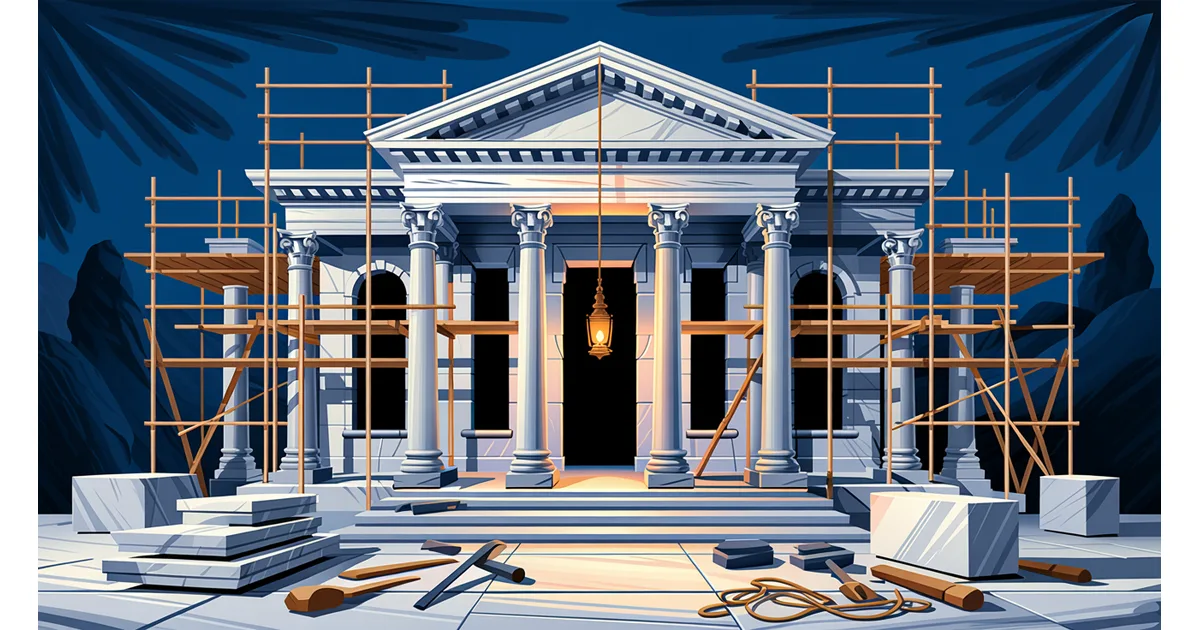
Every custom-build horror story you'll ever hear is a footnote to the first one, because the first one happened to the man who invented American public finance.
In 1794, Robert Morris began constructing a palatial townhouse in Philadelphia. His architect was Pierre Charles L'Enfant, the man who designed the street plan of Washington, D.C. itself. The client was, by the ranking DSDI cites from the Encyclopedia of American Wealth, one of the two richest signers of the Declaration of Independence: the merchant who had run the Revolution's finances, founded the Bank of North America, and put 1.4 million dollars of his own money behind the Yorktown campaign.
The house was never finished. Philadelphians nicknamed the marble carcass "Morris's Folly." It sold at auction in 1799, by which point its owner had been sitting in Prune Street debtors' prison for over a year. He stayed three and a half years, released in 1801 only because a new federal bankruptcy law passed, and he died in 1806 living on an annuity a friend arranged.
If the smartest financial operator of the founding generation couldn't survive his own dream build, it's worth spending seven minutes on what the wreck actually teaches.
What took him down (the build was the symptom)
Honesty first: the mansion alone didn't bankrupt Robert Morris. The DSDI biography lays out the full sequence. After leaving the Senate in 1795, he plunged into land speculation at a scale that sounds invented: he owned the western half of New York State at one point, and with partners exercised options on more than 6 million acres. The financing he counted on from Holland never materialized once the French Revolution and Napoleon swallowed Europe's capital. A buyer (Talleyrand, no less) took 100,000 acres and never paid. A politically motivated lawsuit pressed by Aaron Burr stripped him of hundreds of square miles. Then the Panic of 1797 called every debt at once, and the American Battlefield Trust puts the final wreckage at nearly three million dollars owed.
But the Folly is the part of the story you can stand in front of. It's what over-extension looks like when it's rendered in marble: a bespoke architectural statement, commissioned at the absolute top of its owner's borrowing curve, that consumed cash while producing nothing, couldn't be paused gracefully, and couldn't be sold as anything but salvage.
Four lessons the Folly still teaches builders
1. A celebrated designer is not a fixed price. L'Enfant was the most famous planner in America. Fame buys vision; it does not buy budget discipline or a completion date. The modern version of this decision is the difference between a bespoke architect build and a production builder's contracted price on a proven floor plan. We ran that comparison in detail in production builders vs. custom homes, and the short version is: the production builder's boring repetition is precisely what makes the number on the contract real.
2. Never commission the dream house at the top of your borrowing. Morris started the mansion in 1794, while his land positions were still opening and his credit still looked infinite. The house's cash demands then ran head-on into the Panic of 1797. Anyone who has watched a construction loan float against a rate spike knows this shape. The right time to build big is when the rest of the balance sheet is quiet, a theme that runs through our build vs. buy math for 2026.
3. An unfinished house is worth less than the sum of its receipts. The Folly sold at auction as an incomplete shell. Half-built custom projects always do; the market pays for finished, permitted, livable square footage, not for embedded ambition. This is also the quiet argument for building where completion is fast and predictable, which is much of what separates the winners in our state-by-state ranking of where to build.
4. The house you build is consumption unless the numbers say otherwise. Morris didn't underwrite the mansion; he expressed himself with it. That's allowed, but only if you label it honestly and size it so it can't sink you. Buyers make the mirror-image error with resale homes all the time, paying for emotional finish while ignoring the 25-year cost engine underneath, which is the core of the classic home-buying mistakes.
The strange epilogue
Here's the detail that makes the story land. Robert Morris, the man whose own house was auctioned unfinished, is painted into the dome of the U.S. Capitol. Constantino Brumidi's 1865 fresco, The Apotheosis of Washington, rings the Rotunda canopy with six allegorical scenes, and the Architect of the Capitol's official description of the Commerce scene reads: "Mercury handing a bag of money to Robert Morris, financier of the American Revolution." The god of commerce, winged cap and caduceus and all, hands a bag of gold to the founder who died broke. His actual Market Street home, meanwhile, had served as the presidential residence in the 1790s, per the American Battlefield Trust. The man housed presidents and gods better than he housed himself.
The Resale Trap's whole argument is that housing decisions should be made on total-cost math rather than sticker price or sentiment. Morris had no NAHB component-lifespan tables and no state-by-state cost model; he had confidence, credit, and L'Enfant's drawings. You have better tools. Use them before the marble arrives.
Fact-check notes and sources
- The 1794 L'Enfant townhouse, the "Morris's Folly" name, the 1799 auction, wealth ranking, land speculation details (western New York, 6 million acres, Holland loan failure, Talleyrand default, Burr lawsuit), Prune Street debtors' prison and the three and a half years, 1801 bankruptcy-law release, annuity, death in 1806, Bank of North America, $1.4 million Yorktown stake: DSDI, Robert Morris
- Panic of 1797, nearly $3 million in debts, prison 1798 to 1801, "Morris's folly" as uncompleted manor, Market Street house as presidential residence in the 1790s: American Battlefield Trust, Robert Morris: Financier of the American Revolution
- Fresco description, artist, and the quoted Commerce scene: Architect of the Capitol, Apotheosis of Washington
- Fresco symbolism context (Mercury's winged petasus and caduceus as commerce iconography): American Essence, The Apotheosis of Washington. Note: that essay describes the Mercury scene but does not name Morris; the identification is from the Architect of the Capitol description.
- Claims appearing in only one source (the $1.4 million figure) are attributed inline to that source.
This article is informational, not financial, construction, or investment advice. Historical institutions are referenced as nominative fair use; no affiliation is implied.
Want the Full Data?
This article draws from The Resale Trap — 395 pages of sourced research covering total cost of ownership, all 50 states ranked, insurance mechanics, and more.
Part of The Trap Series
The W-2 Trap → The $97 Launch → The Condo Trap → The Resale Trap
