
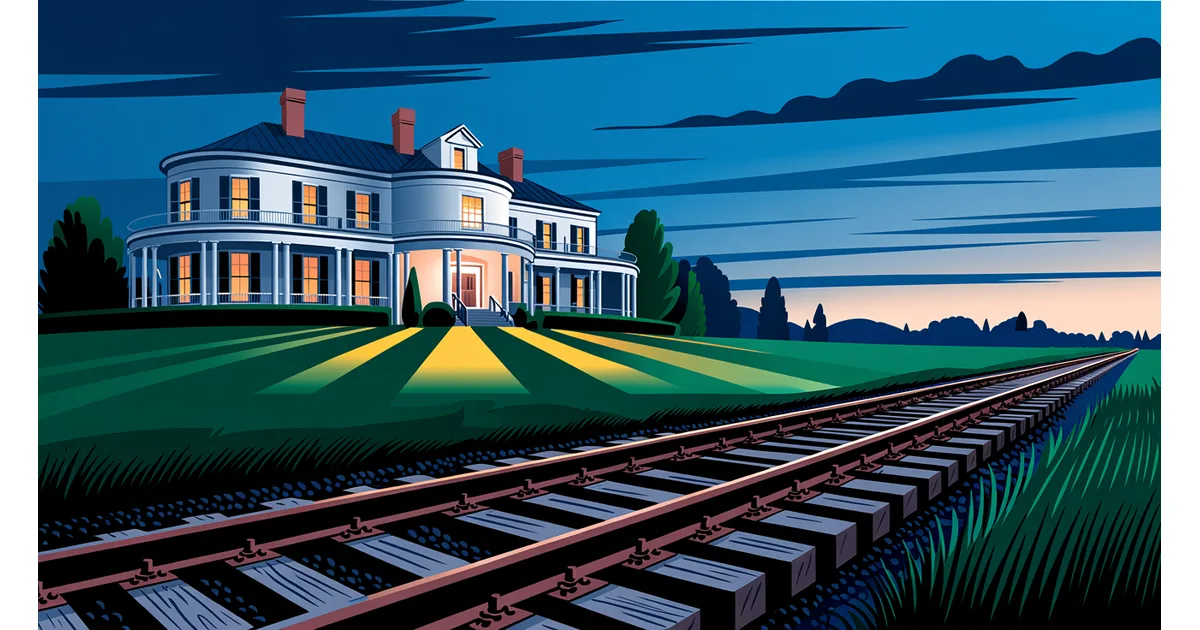
We told the story of Morris's Folly, the founding era's first custom-build disaster. Here's the second one, and it's more useful, because this one actually got built, got lived in, and still failed, which lets you watch the whole life cycle of a dream house whose underlying math never worked.
The builder wasn't a naive client. Henry Knox was the logistics genius of the American Revolution, the self-taught artilleryman who moved sixty tons of captured cannon 300 miles over frozen rivers and mountains by ox sled without losing a single gun, then served nine years as the nation's first Secretary of War. A man, in other words, who calculated loads, routes, and supply for a living, at the highest level, under fire.
In 1794 he began building his dream estate. By 1806 he was dead and the estate was drowning in debt. By 1871 the house itself was demolished to make room for a local railroad line. The mansion tourists visit in Thomaston, Maine today is a 1929 re-creation: a replica of a house that survived its builder by 65 years but its builder's arithmetic by zero.
What he built, and on what
Knox's claim to Maine came through marriage. His wife Lucy's grandfather held the Waldo Patent, 576,000 acres of midcoast Maine; her Loyalist family fled to England during the Revolution and forfeited their American holdings, except what Lucy stood to inherit. Per the Maine Memory Network's account, Knox assembled most of the patent through purchase and by asserting Lucy's inheritance rights.
So far, that's an asset. The problems started with what he stacked on top of it:
The house came first. Montpelier went up in 1794, the year before Knox left the War Department, a grand mansion sized for the lord of a half-million-acre domain. Note the sequence: the fixed, cash-consuming showpiece was built before the income that was supposed to carry it existed. Mount Vernon's encyclopedia records that Knox was already taking weeks away from his cabinet job in 1794 "to manage personal financial concerns." He broke ground on the dream while the ledger was already bleeding.
The income was all speculation. To make the domain pay, Knox launched ventures in volley: land sales to settlers, shipbuilding, lime burning, brick works, a wharf and store. Ambitious, diversified-looking, and all of it new, unproven, and capital-hungry at once. His land partners included William Duer and later William Bingham, and the contrast with Bingham is the whole lesson: Bingham bought two million Maine acres with banked cash and other income engines running, and died rich. Knox bought a lifestyle with the land's future earnings, and the future declined to cooperate on schedule.
The asset came with enemies attached. Revolutionary War veterans and other settlers had cleared and improved parts of the Waldo Patent during Knox's years in the cabinet, and considered the land their earned pay for the war. Asserting an old Loyalist family's patent over them bought Knox years of disputes, commissions, and public hatred, including a savage 1796 pamphlet, The Unmasked Nabob of Hancock County, that parodied his will: "I will to my oldest son, sixty-seven thousand pounds to spend at gaming and carousing." Title risk, in every era, is carried by the buyer.
How it ended
Knox ran the machine hard for a decade; his own account books show a 15,000-acre sale as late as September 1805. It wasn't enough. The businesses failed, holdings were sold to cover debts, and when he died suddenly in October 1806 at fifty-six (an infection from a swallowed chicken bone, one of history's crueler footnotes), his widow and children inherited what the Maine sources describe as a mountain of debt. The decades after are a slow-motion liquidation: land sold piecemeal to creditors, then the house itself passing out of the family in 1871 and being torn down for a railroad right-of-way. The grandest private home in Maine couldn't outlast the ordinary commercial value of the dirt under it.
Four rules from the wreck
1. Build the income, then the house. Montpelier inverted the order that works. If the dream house is the reward for a portfolio that already pays, it's consumption you can afford. If the house is built on what the ventures will earn, you've made your home the most junior creditor of your riskiest projects. Our build vs. buy math assumes the money exists; Knox's case is what happens when the build is the bet.
2. A grand house is a payroll, not an asset. Heat, staff, upkeep, entertaining, appearances: an estate bills its owner monthly, forever, regardless of how the lime kiln did this quarter. It's the same carrying-cost logic as the hidden costs that stalk any oversized home purchase, scaled to mansion size. Knox mastered military logistics, where operations end; he built a domestic operation that never ends.
3. Don't fund fixed costs with speculative income. Every one of Knox's revenue streams was volatile: land sales dependent on settler demand, shipping, commodity lime and brick. Every one of his costs was fixed: the mansion, the lifestyle, the interest. Volatile in, fixed out is the classic ruin shape, whether it's an 18th-century general or a 2026 buyer qualifying for a construction loan on commission income and best-case rents.
4. Heirs inherit the carry, not the dream. Lucy Knox got the mountain of debt, and the family spent decades feeding the estate to creditors. A house that only works while its builder is alive, optimistic, and earning is not a legacy; it's a liability with a bedroom count. The disciplined alternative, buying or building at a price and carry your worst year can survive, is boring precisely because it's inheritable. That discipline, priced state by state and system by system, is the entire argument of The Resale Trap.
One respectful footnote: nothing here dims the first half of Knox's life. The man saved Boston with oxen and arithmetic. Which is exactly why his second act matters to anyone planning a build: if a logistics genius with a half-million-acre head start can't make a dream estate carry itself on hope, the neighborhood's biggest custom build won't beat the math either. The math doesn't care whose name is on the gate. Or, eventually, whose railroad runs through it.
Fact-check notes and sources
- The Waldo Patent and ventures (576,000 acres via Lucy's grandfather Samuel Waldo, the Flucker family's flight and forfeiture except Lucy's inheritance, acquisition by purchase and asserted rights, ventures and partners including William Duer and William Bingham, settler and veteran conflicts, the 1796 Unmasked Nabob pamphlet and quoted mock will, the September 24, 1805 sale of 15,000 acres): Maine Memory Network / Thomaston narrative, "Henry Knox: Land Dealings", a Maine Historical Society project.
- Montpelier's timeline (built the year before his 1795 retirement on land Lucy inherited, in the family until 1871, demolished for a local railroad line, the 1929 re-creation standing today): American Battlefield Trust heritage-site page, "Montpelier".
- Knox's career and finances (the Ticonderoga train, first Secretary of War 1789-1794, the late-1794 retirement after weeks of absence to manage personal financial concerns, the move to Maine, death in 1806): Mount Vernon Digital Encyclopedia, "Henry Knox" and American Battlefield Trust, "Henry Knox" (sixty tons of cannon, the chicken-bone death October 25, 1806, burial at Thomaston).
- The failed-businesses and debt summary ("mountain of debt," piecemeal sales) follows the Maine historical sources aggregated above; specific figures for Montpelier's construction cost are given in none of the consulted sources and no number is invented here.
- The Bingham comparison: sourced in its own post.
This article is informational, not financial or construction advice. Historical institutions are referenced as nominative fair use; no affiliation is implied.
Want the Full Data?
This article draws from The Resale Trap — 395 pages of sourced research covering total cost of ownership, all 50 states ranked, insurance mechanics, and more.
Part of The Trap Series
The W-2 Trap → The $97 Launch → The Condo Trap → The Resale Trap
